

ABOUT > MY STORY
Been There, Done That
Discover the professional journey that shaped my perspective, expertise, and approach, from corporate HR leadership to consulting and teaching — a mix of hands-on experience, strategic insight, and real-world results.
WHO AM I?
By Profession -
By Profession -
By Profession -
I am a talent management executive with 25+ years of corporate experience
By Choice -
By Profession -
By Profession -
I am an external partner in architecting engaging experiences, processes, and teams across the talent lifecycle
By Calling -
By Profession -
By Calling -
I am talent-centric and employee experience-obsessed
I've always been drawn...
... to the creative process involved in program design and to coming alongside people to help them grow and develop.
My first dream was in architecture but I found my calling in talent management just as it was first being established. What distinguished my work was not simply program design, but the ability to translate business strategy into talent systems that could sustain performance.
After 20 years of corporate success, I launched TALENT CENTRIC DESIGNS as the culmination of my journey and the experiences that have shaped me.
Now, I get to dedicate my time to partnering with senior leaders who share my beliefs about the inherent value of their people and who know that clarity of strategy and aligned talent systems are not “HR processes,” they are multipliers of enterprise performance.
Learn more of my story, and view my credentials, below.
MY STORY
I’ve always been drawn to building things.
As a child, I imagined becoming an architect, turning ideas into structures that were both beautiful and functional. I was fascinated by how design shaped experience. How the way something was built influenced how people moved, interacted, and thrived within it.
Well, spoiler alert: I didn’t become an architect of buildings. Instead, I became an architect of organizations.
I began my career in the late 1990s, serendipitously just as talent management was emerging as a formal discipline inside HR.
Over the next two decades, I had the opportunity to build across the entire talent lifecycle inside large, complex enterprises, using the latest research in this new field. I designed and led initiatives in talent attraction, executive development, succession planning, engagement, culture transformation, organizational effectiveness, and more – pretty unique if I’m one to brag. This breadth allowed me to see the interdependencies between these processes and to architect them as cohesive systems rather than isolated programs.
Many of the programs I’d built were recognized and written up as best-in-class. Along the way I’d also studied for and earned my MBA and several certifications.
What defined my work, though, wasn’t breadth or accolades. It was integration and impact.
I was counted on not only to design strategy, but to operationalize it, to translate vision into scalable systems that could actually work, could actually drive measurable enterprise impact.
Like architecture, talent work requires both concept and construction. Strategy without deployment fails. Deployment without design drifts. I’m able to do both; in fact, a leader once called me “an ideator who implements.”
Over time, a throughline, a point of view, became clear to me. Organizations perform at their best when they are intentionally architected around the inherent value of people. Not performative “people-first” language, but structured teams, processes, and programs that unlock discretionary effort, leadership clarity, and aligned accountability.
After more than 20 years leading and building inside corporate environments, I made the intentional decision to step outside them.
I had long known that I wanted to do this work across multiple organizations, so I could partner with leaders navigating growth, transformation, or complexity, and help them architect environments where both people and performance could scale together.
In 2020, that intention became action. TALENT CENTRIC DESIGNS was born from both conviction and experience. It was a culmination of decades spent building high-performing teams and talent programs, a belief that human-centered design is not soft, but strategic, and the knowledge that anyone could unlock this with the right help and guidance, not just the biggest organizations with the biggest budgets.
Today, I partner with executive teams across industries to design talent strategies, organizational structures, and HR mindsets that drive measurable enterprise impact.
In parallel, I serve as an adjunct professor at the University of Denver, teaching graduate students about talent management, organizational design, and organizational effectiveness — preparing the next generation of HR leaders to think systemically about performance and people.
My work and thought leadership have been recognized through national publications and speaking engagements, and I am honored to be named a LinkedIn Top Voice for my contributions on employee experience, culture, and performance.
What about the dreams of that little girl? Well, I still think like an architect. The materials are different; instead of buildings of stone and steel and glass, I build impactful cultures, experiences, and teams. And the purpose remains the same:
To design environments where people can thrive — and where organizations can perform at their highest potential.
MY CREDENTIALS
- 25 years leading across all areas of talent management
- Experience as a leader inside 5 different Fortune 500 companies (5000 to 65,000 people) and as a consultant to companies ranging from less than 100 to over 1,500 people
- Adjunct professor, teaching in the University of Denver's Strategic HR masters program
- Track record of hundreds of best practice talent and HR programs designed and deployed
- MBA in organizational management from the Daniels College of Business at the University of Denver
- Thought leader featured in over 25 publications in articles about culture, employee experience, and talent management
- LinkedIn Top Voice and sought after keynote speaker in #culture, #employeeengagement, #employeeexperience
- Gallup-Certified Strengths Coach
- Certified Team Performance Practitioner, by Grove
- Certified Talent Advisor, by CEB (now Gartner)
- Certified Recruitment Leader, by Human Capital Institute
- Winner of Intergenerational Kindness Award, Store with a Heart
- Named a Best Keynote Speaker in the USA
- Clifton Strengths Top 5 - Maximizer, Achiever, Individualization, Input, Command
- Stroke and Turn Official, USA Swimming
- Mom of Zachary, who bests me in golf (and many other things)
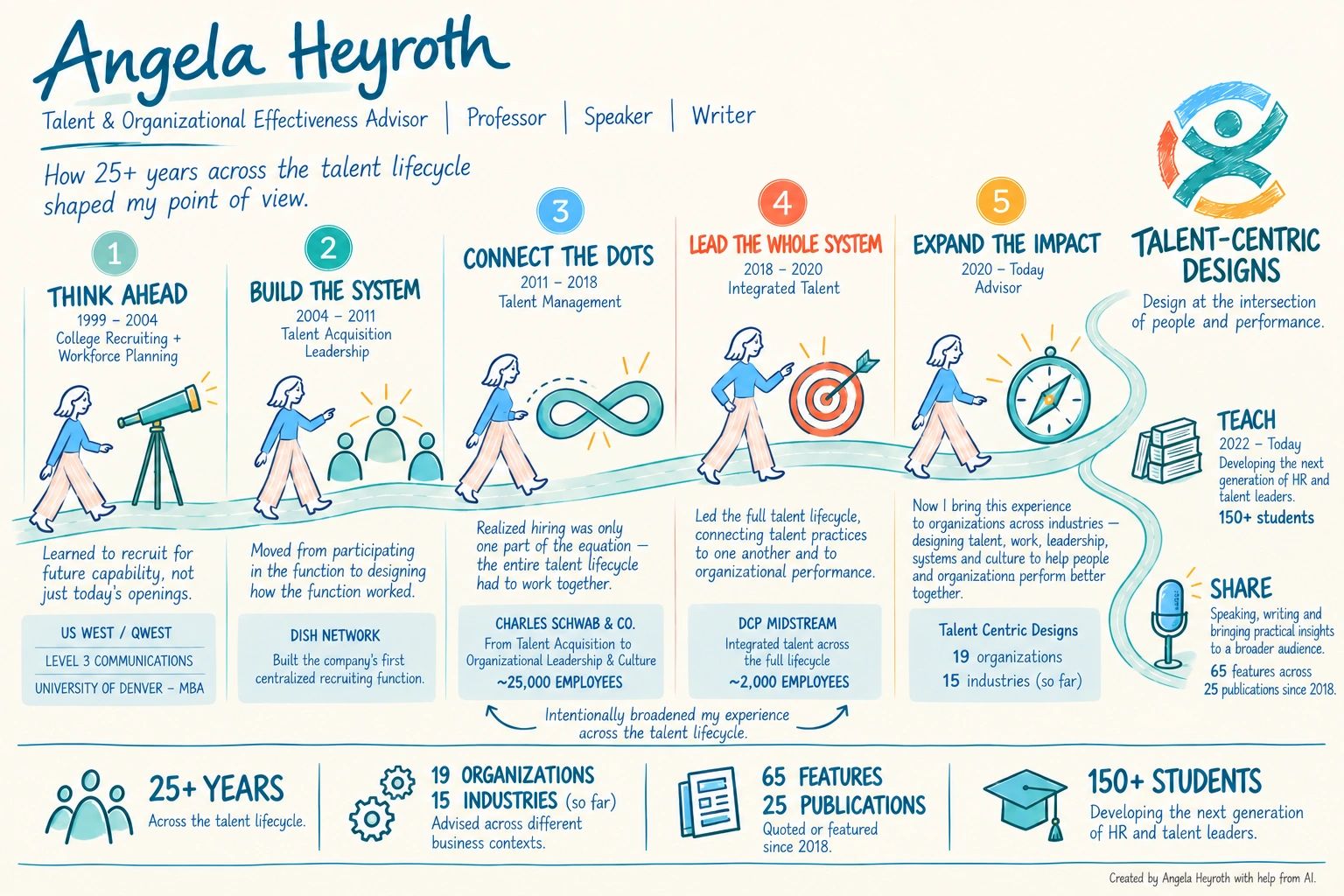
My Career, At a GLaNce
From recruiter to enterprise talent leader to advisor, professor, and speaker, here's a visual look at the experiences that shaped how I work today.
Want a closer look? Open the image in a new tab to view it full size.
Q&A WITH ANGELA
The short answer is that I partner with organizations to create engaging employee experiences and teams.
The longer answer is that I am obsessed with the employee experience because it is the single biggest multiplier to business results I have seen, so resources spent on architecting experiences across one or more phases of the talent lifecycle are investments in business outcomes, and I believe every body deserves access to these experiences because it makes the workplace a better place to be and therefore increases business success. Win-win!
I spend my days guiding companies on the creation of engaging experiences and teams, and the results that come with that are impactful and exciting.
For me it was always about making things work better, driving progress. I could see even at an early age that when organizations focused on doing right by their people, that performance and profitability followed. So for me, HR wasn't about helping people thrive but about ensuring organizations could thrive because of the way they cared for, engaged, and grew their people as a central focus.
It's so hard to identify one thing when my whole career has been about designing and introducing evolved and new experiences. One big change that impacted many others was shifting our focus on surveying employees as more of a check-box to really going in deep to assess their voice and their feedback as it related to our culture and overall experience at the workplace. It changed everything about the programs my team was running and how we all thought about engagement and employee voice.
I started my career in college recruiting in the late 1990's, right before the Y2K scare, when companies were in heavy competition for technical talent in order to correct databases with the change over from two-digit years to four-digit years. Not only did I learn program management from this work but I was serendipitously right at the beginning of the start of the talent management profession, and fortunate to be working for companies on its leading edge, who were later to be studied and quoted in the WAR FOR TALENT book that defined the profession.
So, I cut my teeth in what was a masterclass of talent management, learning the best practices in the best ways. This was followed quickly by the dot-com bust and 9/11, both of which combined to make talent management's purpose be questioned - and that actually had a positive impact on me because it made me start really defining my profession's purpose and impact in very real terms.
That as an external consultant I have all the answers. I have had a lot of experiences and tools, and bring these to bear in ideation sessions with clients, but often times we are co-creating the answers and needed practices based on their needs and unique culture.
I don't have a prescribed model I rely on; every situation and organization is unique, because as humans, we are each unique and that is one of the things that makes our broader HR and Talent profession so interesting.
More and more HR professionals are realizing that our calling is to create an environment in which our people can engage and therefore perform - rather than create policies or run payroll. Those things are absolutely crucial but the driver is an engaging environment and those more operational elements are enablers to driving the engaging environment.
When we lead with experience and engagement rather than activities, we lead with the impact HR has on the organization instead of what HR does, and that shifts the whole conversation and perception. I call this having a talent-centric mindset.
At the same time, as we get more and more specialties in HR, we are becoming more siloed. And when we work in silo's, we don't work strategically together to further the experience and engagement of our people. I am so over the statements like "I'm in the fun part of HR" or "I do bread and butter HR" or "Well I'm in training so I guess I'm in HR but not really" because all those do is separate us from one another and denigrate our colleagues. No one HR function is better than the other, we need all of them for a holistic lifecycle approach for our people.
While I appreciate a really eggy brioche French toast with brown sugar syrup, my preferred breakfast when out is either a veggie benedict (runny eggs! hollaindaise! spinach!) or avo toast. And always, coffee.
BADGES, CERTIFICATIONS, HONORS



Insights Featured in...










Angela exemplifies an exceptional collaborative partner, possessing remarkable wisdom and insight that hold immense value.
Brittany B, Director Talent Management for a university

MY PERSPECTIVE
What is a Chief People Officer?
Why organizations need CPO-level leadership as people and organizational complexity grows, and how the role shifts from running HR to helping run the business through people.

Copyright © 2020-2026 TLD Solutions LLC / AKA Talent Centric Designs - All Rights Reserved
ABOUT: Angela Heyroth is the Founder and Principal of Talent Centric Designs, an organizational effectiveness advisory firm. Her work focuses on Talent & Culture Design and HR Advisory & Enablement, helping HR and business leaders intentionally design talent systems, organizational culture, employee experience, HR operating models, and leadership capability to improve organizational performance. In addition to advising organizations, she is a keynote speaker, adjunct professor, and published contributor on topics related to talent management, strategic HR leadership, organizational design, and the future of work.
This website uses cookies.
We use cookies to analyze website traffic and optimize your website experience. By accepting our use of cookies, your data will be aggregated with all other user data.